


Helping your child with blood tests
If your child struggles to manage procedures involving needless, get in touch to access specialist 1:1 psychological support.
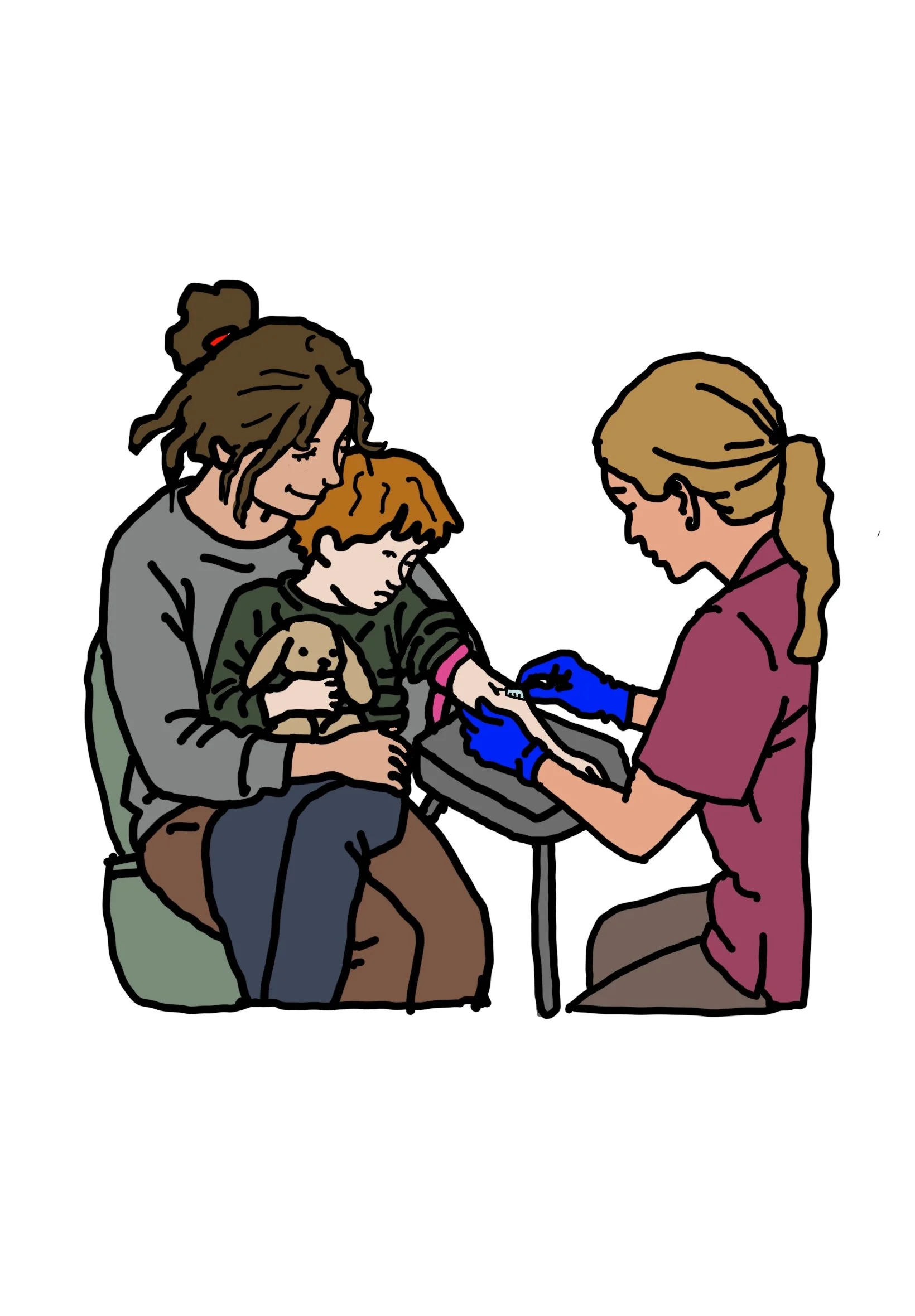
Blood tests can feel scary for children, it’s understandable if your child feels worried about having one. The unfamiliar environment, the equipment, having to sit still and, of course, the anticipation of a needle can all make blood tests feel really frightening. Some children may become upset as soon as they hear that a blood test is coming up, while others may seem fine until they arrive at the hospital or see the needle.
The good news is that there are things you can do to help your child feel more prepared and supported. You don’t need to make the experience completely stress-free. Instead, the aim is to help your child know what to expect, feel that they have some control and to support them to have strategies they can use when things feel difficult.
Here are some practical things you can try.
-
It can be tempting to reassure your child by saying things like, “It won’t hurt at all” or “It’ll be over before you know it”, however, if the blood test does hurt, even briefly, your child may feel more worried or lose trust in what adults tell them.
Instead, use simple, honest language that is appropriate for your child’s age and level of understanding.
You might say: “The needle will go into your arm and you might feel a sharp scratch or a pinch. It might hurt a little, but it won’t last for long”.
Try to avoid giving lots of unnecessary detail. Too much information can sometimes increase anxiety, particularly for children who tend to worry or imagine the worst.
-
Knowing what is going to happen can make something unfamiliar feel more predictable. Before the appointment, explain the main steps in a calm and straightforward way. For example:
“First, we’ll sit in the chair. The nurse will clean your arm. They’ll put a stretchy band around your arm and then use the needle to take some blood. You’ll need to keep your arm still. Then the needle will come out and they’ll put a plaster on”.
You could also show your child a picture or a simple child-friendly visual explanation of a blood test beforehand.
Be mindful of timing. Some children benefit from knowing several days in advance so they have time to prepare, while others become more anxious if they have too long to think about it. You know your child best.
-
Blood tests involve some things that your child cannot control: the needle needs to go in and they need to keep their arm still. Nonetheless, there are usually other things they can have a say in.
For example:
“Would you like to sit up or lie down?”
“Which arm would you like to use?”
“Would you like to watch the blood test or look away?”
“Would you like to watch your favourite video or listen to music?”
“Who would you like to sit next to you?”
Offering small, genuine choices can help your child feel more in control.
Just be careful not to offer choices that aren't really choices. Asking, “Do you want to have your blood test?” can make it sound as though saying no is an option when it may not be.
-
It can be difficult for a child to learn a new coping strategy when they are already very frightened. Having well learned movements or strategies makes it easier to use them when worry affects our thinking.
Practise beforehand, when your child is calm. This might include:
Slow breathing: Encourage your child to take slow breaths, particularly focusing on a longer breath out. You can practise together without making the breathing specifically about the blood test. Some people find it helpful to breathe in through their nose, and out through pursed lips.
Distraction: Think about what will hold your child's attention. This might be a favourite TV show, game, music or looking at something interesting.
Comfort items: A favourite soft toy, blanket or small sensory item can provide something familiar to hold or squeeze.
Muscle relaxation: Some children find it helpful to relax their shoulders, hands and arm rather than becoming very tense.
You can also practise the specific behaviour your child will need during the blood test - for example, keeping their arm still while watching a video, or holding their arm in a certain position.
-
Some children prefer to see what is happening. Others become much more distressed if they see the needle. There isn't one right approach - speak to your child to find out what they would prefer.
If your child prefers not to look, help them choose something else to focus on - perhaps a favourite video, a game on a phone or tablet, or talking to you.
If your child does want to watch, that's okay too. You don't need to insist that they look away. The important thing is finding what helps your child cope.
-
Children are often very aware of the emotions of the adults around them.
If you're feeling anxious, you might find it difficult to stay calm when your child is upset. Try to use a steady voice and simple reassurance rather than repeatedly saying, “Don't worry” or “It’s okay”.
You might say: “I can see you're worried. I'm right here with you. You know what you're going to do to help yourself”.
And remember: it's okay if you find it difficult too. If you know that you become particularly anxious when your child is distressed or around needles, it may be helpful for another trusted adult to take over some of the support. That isn't failing - it's making sure they have a calm adult alongside them.
-
Try to avoid making the success of the blood test about whether your child was “brave” or whether they cried. A child can be extremely frightened and still cope brilliantly.
Instead, notice the specific things they did to manage a difficult situation:
“You were really worried, but you kept your arm still.”
“You used your breathing when you started feeling scared.”
“You looked at your video while the nurse took the blood.”
“You told me when you needed a break.”
Specific praise helps your child understand what they did that helped them cope, giving them confidence the next time they have to do something difficult.
And if the blood test was very difficult? That's okay too - you can still notice what went well, however small!
-
If your child is particularly worried about the pain of a blood test, it can be helpful to speak to the medical team before the appointment about what options are available.
Depending on your child's age, the type of blood test and the healthcare setting, there may be ways to reduce discomfort. For example, the team may be able to advise you about using a topical numbing cream or patch, such as a local anaesthetic cream, before the blood test.
It's worth asking the team:
Is numbing cream or another form of pain relief appropriate for my child?
How long before the blood test does it need to be applied?
Where should it be applied?
Is there anything we need to know about using it safely?
Are there other ways you can help make the blood test more comfortable?
Some hospitals and clinics have specific policies about which products can be used and when, so check with your child's healthcare team rather than assuming that a particular product is suitable.
Pain relief won't necessarily remove all of the anxiety around a blood test, but reducing physical discomfort can make the experience more manageable for some children. Remember never promise pain relief without first speaking to the team to see if it is suitable for your child.
You can also let the healthcare team know what tends to help your child. For example, if they find it easier to have the blood test lying down, prefer not to see the needle or if they benefit from distraction (and have favourite topics!), telling the team in advance can help everyone work together to support them.
-
One of the most important things to remember is that the goal isn't necessarily to make your child feel calm.
Blood tests can be uncomfortable and frightening. Your child may cry, shake, say they don't want to do it or need lots of support - and they can still successfully get through the experience.
Rather than aiming for “How can I stop my child from being scared?”, try thinking: “How can I help my child feel supported and know what to do when they are scared?”
Over time, repeated experiences of being supported through difficult things can help children develop confidence in their ability to cope.
And remember: a difficult blood test doesn't mean you've done anything wrong. Some children will need more preparation and support than others, and that's completely okay.